
Practically Speaking, Before the Final Straw.
On speaking "African", helpful history, and the prevention of implosion.

Thank you for supporting my current pursuit of Freedom from abuse and Intimate Partner Violence.
My intention in sharing my real-time and real-life experience seeking relief from abuse is to shed light on the realities of abuse, and be a positive contributor toward better protections for survivors now, and in the future.
Practically Speaking, Updates.
Thank you so much for the 4 additional lawyer referrals over the weekend. I’ll be reaching out promptly and following up with the lawyers previously contacted regarding the possibility of pro bono help in the absence of funds. My court deadline to secure a lawyer is November 24th—please continue spreading the word and emailing referrals.
Practically Speaking, a History of Final Straws.
The Justice’s frustration has been in my ears since October 16th. It was my second time in that same courtroom amidst rows of lawyers, a handful of us self-represented. I understand that the courts aren’t built for feelings, as a lawyer once told me, “take your social justice issue elsewhere.” But, I was there to raise the alarm about ongoing abuse and to ask for what the law allows: time to retain competent counsel. My exhibits traced the pattern: harm, vexatious conduct, and an obvious power imbalance. When the Justice interrupted: “What do you want me to do? There are social services”, I shut my mouth to not mess up my one objection: more time so a competent lawyer can intervene and ensure my protection from further abuse. What I wanted to say was:
”I’m seeking protection from economic destruction. Social services do not remedy violations of the Divorce Act or the Criminal Code. You can.”
My urgency lives in a wider history. People talk about a last straw or the final hairline crack before a vessel implodes; this is that sound, and it has been building for years. It helps to remember the cracks that come before the implosion, to learn from history to avoid its unfortunate repetition. These are some of mine.
In junior high school, a classmate raised concerns about my safety at home for the first time.
The guidance counsellor skipped the part of talking to me first and went straight to the principal, who had already called my parents first, then me. Even at that young age, I knew that it wasn’t safe to speak up. My young mind weighed the opportunity cost of the foster system, or staying and “toughening up” to survive just a few more years before the liberation of university.
A few years later, the summer my innocence was taken, a priest sent me home with my abuser. He deemed me a “bad girl” who needed to obey her father better; I was given 3 Hail Marys as penance for the sin of trying to get help.
Later in marriage, I learned a new choreography of blame.
There was always money for the boys’ ski trips and for sex workers, but never enough for therapy. I was grateful when I found a new church that offered subsidized counselling, and I got to work on “Project Fix Me”, as though my perfection could tame another’s cruelty or quiet the racism from his family.
For a while, the band-aid fix helped. I smiled politely when asked if I “spoke African”, as my abuser’s relatives pushed the plate of watermelon to me, the only Black person at the family gathering. I released all I couldn’t say into sweat when my abuser’s family would proclaim that “racism doesn’t exist in Canada” through the discovery of my love for spin (indoor cycling). Discipline, confused as punishment, evolved into two Orange Theory classes a day when I was given notes on Joyce Meyer’s style guide to better dress as a “Christian”, and avoid hell. But these methods were not strong enough to combat my experience, or the experience of my future Black children.
I had chosen this church because it claimed allyship and activism. In response to radicalized horrors across the border, I recollect that church’s statement from 2022:
“The rise in white supremacist terror attacks are intended not only to cause pain but to create a climate of fear for our siblings of colour. The church must continue to speak out. But the Canadian church must guard against the imagination that this is an exclusively American phenomenon. Our Indigenous neighbours know the truth too well. We must repent and turn away. We must continue to listen, learn and then act in the pursuit of real peace for all. Lord have mercy. Lord lead us into peace.”
So in June 2025, I wrote my church saying: “I am desperate for help. Continuing alone is no longer sustainable. Please do not turn away from me, I am so desperate for help.”
This response took me a few minutes to understand and reconcile with the actioned response I’d witnessed for refugees and folks in crisis previously: “So awful, sorry to hear you are going through such a horrible situation. Hoping for the right next steps as you journey through this.”
I’m grateful to one of those pastors for donating anonymously to my GoFundMe. I am truly grateful because it enabled provisions to buy much needed protein for the month, rationed carefully. But gratitude for crumbs can make it too easy for leaders to avoid the obligations their titles imply. Why be anonymous in supporting me?

The pattern repeats elsewhere. At the Distress Centre, after procedures were broken when I reached out for help, I requested my call transcript. After several follow-ups, I received a heavily redacted document; thick black lines where accountability might have lived, many months later.
When I applied to the AHS Day Hospital Program, my intake psychologist wondered aloud why her colleague had complained after she told them that she “doesn’t see colour”. Apparently, to her, I could speak for the experience of another Black person to help ease her guilt and ignorance.
The scene felt like “Get Out” brought into clinical daylight, when she leaned in closer to tell me about her “rainbow heart” and the moccasins on her feet. She confirmed she was not Indigenous—I felt that was sufficient evidence to refrain from speaking further about this topic.

My most recent lawyer was a friend from high school.
He was someone whom I trusted. He had witnessed my experience as the only Black student on campus until my final year; he knew about the full scope of my abuse. He once connected that history to today: the same harm, but in a new body. Yet fast forwarding a year, he was now advising me there is no power imbalance, no oppression, no economic fallout—all from false clauses in the agreement draft waiting for my signature. When I questioned this draft agreement that erases the truth, right as a bailiff came to repossess my car for something my abuser did, my friend, my lawyer, withdrew. Abruptly and with no revisions to leave me less protected than before.
Frighteningly, it is the ease with which this pattern of abandonment and dismissal continues.
It is the ease with which my insurance broker removes me from my own life and disability policy. The ease with which car insurance changes ownership without my consent or knowledge. The ease with which police dismissed repeated requests for help. I have approached every “proper authority.”
This ease is why I’m speaking here: to create a public record that cannot be erased, for myself and for the many who never get to speak before the system swallows them whole.
The term ‘Plausible Deniability’ comes to mind. It describes when someone deliberately maintains just enough ignorance to later claim, “I didn’t know,” while benefiting from or enabling harm. In social or institutional contexts, it’s a tool of self-protection and power maintenance: by pretending not to recognize racism or harm, a person or system can deny intent and therefore avoid accountability.
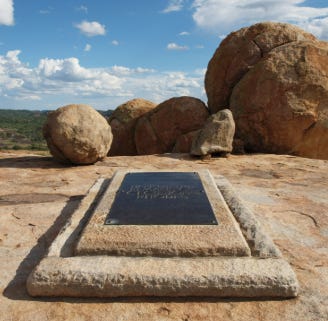
My abuser stood with me in Zimbabwe outside Cecil Rhodes’ home; he heard the history, he saw the poverty, and he intimately understands the absence of protection I live with.
He knows. He knows. He knows.
And because he knows, plausible deniability is no longer available—not to him or to the authorities who looked away. By sharing my own history, I refuse the spectacle of “coulda, woulda, shoulda” at a podium for an avoidable funeral. I have had enough of falling through the cracks. I have had enough of carrying the weight of my abuser’s consequences.
I have had enough of being ignored by systems, white male mediators telling me about how they worked at a mill 25 years ago to pay for law school. With all due respect, I do not need a lesson on resilience from this person of privilege. I’ve had enough of the broken record for me to be the bigger person. It is time for my abuser, he to whom so much has been given, to stop acting so small.

Practically Speaking, Hope in Restorative Justice.
With this helpful historical context, I hope to leave it here. No longer trapped by the stories of the past, I focus on advocating for a future of Freedom. I focus on being a joyful being, even if this nightmare isn’t over yet.
Despite all this harm and trauma, I still believe in the Light. I still believe in restorative justice. I still believe in healing, even for my abuser.
I leave you with this powerful quote from Yara Shahidi:
“… even in this nightmare, this is a manifestation of somebody’s wildest imagination. There’s many people that would have given their lives to be a part of this version of the fight, and that is part of the project we are all participating in now… we do deserve to be selfish and desire a better future right now. But so much of the work is in this investment, in a future, in things that we may not have the ability to witness ourselves. That continues to inspire me.”
With reflective gratitude, I think of my Gogo Mary, who walked across country borders for a better life. And in gratitude for that Freedom she died before witnessing herself, I keep fighting for the real thing—not a modern sentence dressed up as order. Not at the hands of a white man whose conscience can now so easily justify cruelty, coercion and oppression.
Thank you so much again for the 4 additional lawyer referrals over the weekend. I’ll be reaching out promptly and following up with the lawyers previously contacted regarding the possibility of pro bono help in the absence of funds. My court deadline to secure a lawyer is November 24th—please continue spreading the word and emailing referrals.
If this resonated, please subscribe, share, donate, and stay connected.
In Gratitude and Freedom,
Kaeyae Alo
✨ Dedicated to the 🟣 movement happening right now in South Africa.
Keep fighting! Your truth and power will get you through the next chapter and we’ll be right there with you 🥊
As I live to witness these chapters and stand as someone who has heard and seen these events as well, I also stand with you in a joyful freedom awaiting and am grateful for additional referrals this week. A nightmare, yet laid out and documented so well here for others to take careful note of. That is an act of generosity that will come back to you, too, my dear friend. Thank you for the quote as well. In Gogo’s legacy we stride and stand until freedom is found 🧡